

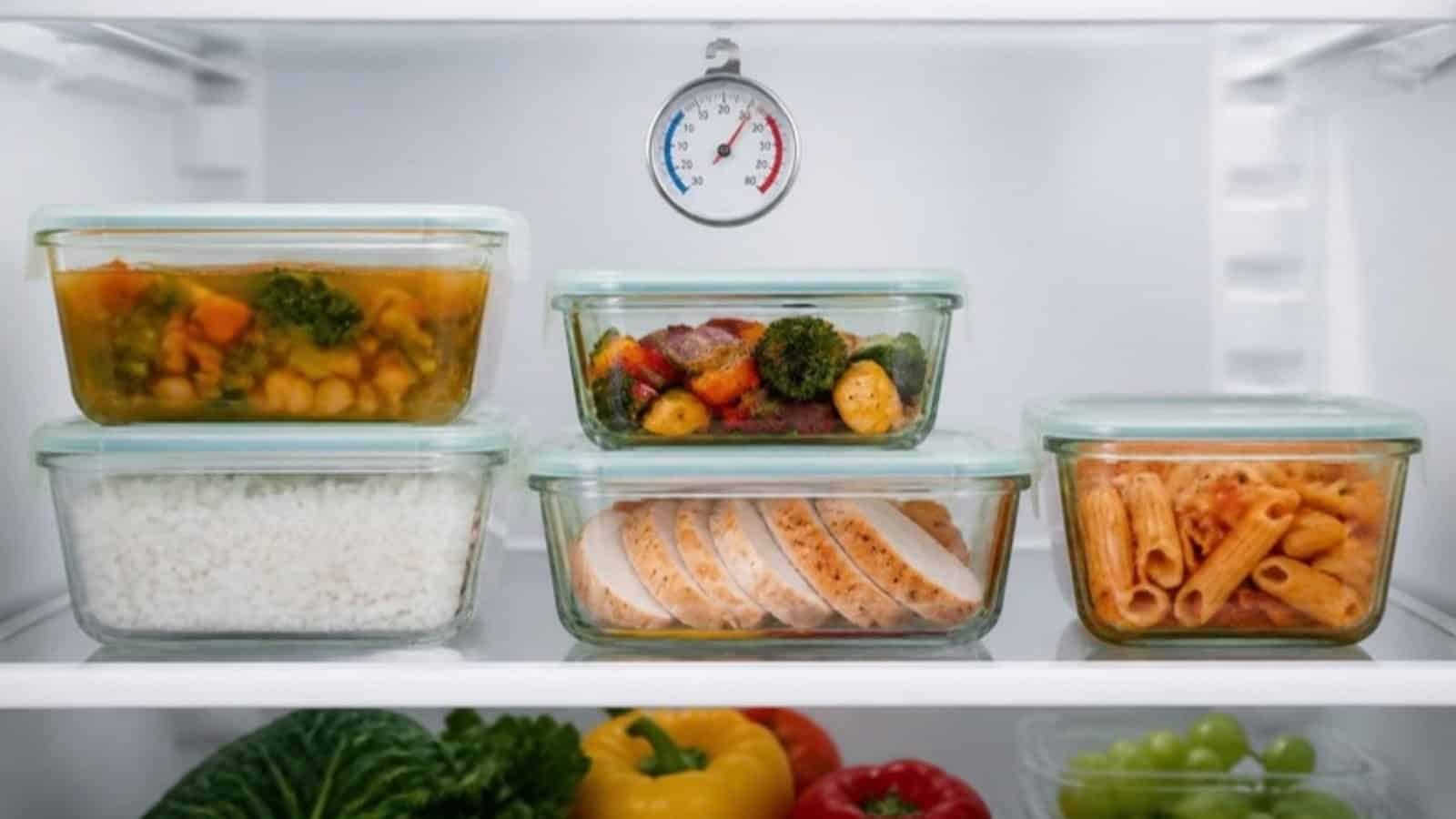
Most cooked leftovers last 3 to 4 days in the refrigerator at 40°F (4°C) or below. Get them into the fridge within 2 hours of cooking, or within 1 hour if it’s hotter than 90°F (32°C). In the freezer at 0°F (-18°C), leftovers stay safe indefinitely, although their quality fades over time. When you reheat leftovers, heat them to 165°F (74°C).
That’s the short version. Below you’ll find a food-by-food chart, the USDA rules behind those numbers, and simple habits that help you use leftovers safely before they go to waste.
Leftovers Storage Chart: Fridge and Freezer Times by Food
| Food | Refrigerator, 40°F (4°C) or below | Freezer, 0°F (-18°C) or below (best quality) |
|---|---|---|
| Cooked meat or poultry (including roast or rotisserie chicken and turkey) | 3 to 4 days | 2 to 6 months |
| Chicken nuggets or patties | 3 to 4 days | 1 to 3 months |
| Pizza | 3 to 4 days | 1 to 2 months |
| Soups and stews | 3 to 4 days | 2 to 3 months |
| Casseroles with eggs, after baking | 3 to 4 days | 2 to 3 months |
| Chicken, egg, tuna or macaroni salad | 3 to 4 days | Does not freeze well |
| Cooked fish | 3 to 4 days | 1 to 2 months |
| Cooked pasta | 3 to 5 days | 1 to 2 months |
| Cooked rice | 3 to 4 days | 1 to 2 months |
| Cooked vegetables or potatoes | 3 to 4 days | 1 to 2 months |
| Hard-cooked eggs | 1 week | Do not freeze |
For chicken salad, see our guide to how long chicken salad lasts in the fridge and why it doesn’t freeze well.
How Long Are Leftovers Good For? The 3-to-4-Day Rule
The USDA Food Safety and Inspection Service (FSIS) says leftovers can be kept in the refrigerator for 3 to 4 days. That’s the guideline to remember for most cooked food, from last night’s chicken to a pot of soup.
A few foods have a different window, which is why the chart is useful. Hard-cooked eggs, for example, keep for 1 week in the refrigerator, while cooked pasta has a range of 3 to 5 days in USDA’s FoodKeeper guidance.
Are leftovers good for a week?
For most cooked leftovers, no. A week is longer than the 3-to-4-day USDA guideline for cooked meat, poultry, soups, casseroles, pizza and similar dishes. If you know you won’t eat something within that window, freeze it early instead of waiting until day 4.
How Long Can Leftovers Sit Out?
No more than 2 hours at room temperature. If the temperature is above 90°F (32°C), such as at a summer picnic or in a hot car, the limit drops to 1 hour.
FSIS advises discarding perishable foods, including meat, poultry, eggs and casseroles, that have been left at room temperature longer than that. The clock starts when the food comes off the stove or out of the oven, or when it’s removed from an appliance that was keeping it warm, so buffet dishes and slow-cooker meals count too.
How to Store Leftovers Safely in the Fridge
Good storage starts as soon as the meal ends.
Cool them quickly in shallow containers
FSIS recommends dividing large amounts of food into shallow containers so they cool faster. A big pot of soup or chili can take a long time to cool all the way through, so split it up rather than refrigerating the whole pot. Hot food can go straight into the refrigerator; you don’t need to wait for it to cool on the counter.
Cover them and keep your fridge at 40°F (4°C) or below
Store leftovers in covered containers and keep your refrigerator at 40°F (4°C) or below. That temperature is the basis for every refrigerator time in the chart above.
Write the date on the container
A strip of tape and a marker save a lot of guessing. Writing the cooking date on each container makes the 3-to-4-day rule easy to follow, especially when several people share the same fridge.
Freezing Leftovers: Safety vs. Quality
Freezing is the easiest way to keep leftovers longer, but it helps to understand what the freezer times mean.
How long do frozen leftovers stay safe?
Food kept frozen continuously at 0°F (-18°C) or below stays safe indefinitely, according to FoodSafety.gov. The freezer times in the chart are about quality, not safety. After that point, food may lose flavor and texture, but it doesn’t become unsafe because of the time alone. FSIS suggests using frozen leftovers within 3 to 4 months for best quality, and the chart gives food-by-food ranges.
How to thaw leftovers safely
Thawing in the refrigerator is the safest method. It takes the longest, but leftovers stay safe the whole time. FSIS also describes thawing in cold water in a leak-proof bag, or in the microwave. You can also reheat frozen leftovers without thawing them first: soups and stews in a saucepan or microwave, and casseroles and combination meals in the oven or microwave.
Can you refreeze thawed leftovers?
Yes, in two situations described by FSIS. Leftovers thawed in the refrigerator can be refrozen without reheating, and you can use them within 3 to 4 days instead. It’s also safe to refreeze any food left over after reheating previously frozen leftovers to 165°F (74°C).
How to Reheat Leftovers Safely
Reheat leftovers until they reach 165°F (74°C), measured with a food thermometer. FSIS recommends checking the temperature in several places, especially with thick or dense foods.
- Microwave: Cover the food and rotate it for even heating, then let it stand for a short time before checking the temperature.
- Sauces, soups and gravies: Bring them to a rolling boil.
- Frozen leftovers: You can reheat them straight from the freezer; just allow extra time and check the temperature in several spots.
How Long Are Restaurant and Takeout Leftovers Good For?
The same rules apply to restaurant and takeout food. Refrigerate leftovers within 2 hours of when the food was served, or within 1 hour if it’s above 90°F (32°C), and remember that time spent in the car counts. FSIS lists cooked meat or poultry and pizza from takeout at 3 to 4 days in the refrigerator, and recommends reheating foods that contain meat or poultry to at least 165°F (74°C).
If a takeout meal sat on the table for most of the evening before it reached the fridge, it’s safer to throw it out.
How to Tell If Leftovers Have Gone Bad
Storage time and temperature are the most reliable guides. Throw leftovers away once they pass the refrigerator time in the chart, or if they sat out longer than 2 hours (1 hour above 90°F / 32°C), even if they look and smell fine.
Appearance and smell can’t confirm that leftovers are safe. The U.S. Food and Drug Administration warns that food can make you very sick even when it doesn’t look, smell or taste spoiled, and FSIS explains that the bacteria that cause foodborne illness are different from the spoilage bacteria that cause off odors and textures.
Mold, a sour smell or a slimy texture are reasons to throw food out right away. But the absence of those signs doesn’t mean food is safe, and you should never taste leftovers to decide whether they’re still good. When in doubt, throw it out.
Use Leftovers Before They Go to Waste
The best leftover is one that gets eaten on day 2, not tossed on day 5. A little planning helps:
- Plan a leftovers night. Pick one dinner a week to finish what’s in the fridge.
- Cook once, eat twice. Make extra on purpose and turn it into a different meal within the 3-to-4-day window.
- Freeze early. If you won’t eat something within 3 days, freeze it in meal-size portions right away.
- Keep leftovers visible. Put them at eye level in clear containers so they don’t get lost behind newer groceries.
Using leftovers well is one of the simplest ways to cut food waste and stretch your food money. If you’re setting a monthly food budget, our guide to a realistic grocery budget for a family of four breaks down the latest USDA food cost figures.
Storage Guides for Specific Foods
The chart above gives the quick answer for common leftovers. For foods with their own storage questions, our detailed guides go further:
We’re adding guides for more everyday leftovers, and this list will grow as they’re published.
Frequently Asked Questions
How long are Thanksgiving leftovers good for?
Thanksgiving leftovers such as turkey, stuffing and side dishes follow the same rule: 3 to 4 days in the refrigerator, according to FoodSafety.gov. Store them within 2 hours of cooking. Frozen, they’re best within 2 to 6 months. Reheat them to 165°F (74°C), and bring gravy to a rolling boil.
Does the 3-to-4-day clock restart after you thaw leftovers?
For leftovers thawed in the refrigerator, FSIS says to use them within 3 to 4 days after thawing, or refreeze them. If you thaw leftovers in the microwave, FSIS says to keep heating them until they reach 165°F (74°C).
References
- FoodSafety.gov. Cold Food Storage Chart. https://www.foodsafety.gov/food-safety-charts/cold-food-storage-charts
- FoodSafety.gov. FoodKeeper App (USDA Food Safety and Inspection Service). https://www.foodsafety.gov/keep-food-safe/foodkeeper-app
- FoodSafety.gov. Thanksgiving Leftovers for Safe Keeping, Weekend Grazing. https://www.foodsafety.gov/blog/thanksgiving-leftovers-safe-keeping-weekend-grazing
- USDA Food Safety and Inspection Service. Leftovers and Food Safety. https://www.fsis.usda.gov/food-safety/safe-food-handling-and-preparation/food-safety-basics/leftovers-and-food-safety
- USDA Food Safety and Inspection Service. Safe Handling of Take-Out Foods. https://www.fsis.usda.gov/food-safety/safe-food-handling-and-preparation/food-safety-basics/safe-handling-take-out-foods
- USDA Food Safety and Inspection Service. Food Product Dating. https://www.fsis.usda.gov/food-safety/safe-food-handling-and-preparation/food-safety-basics/food-product-dating
- U.S. Food and Drug Administration. Are You Storing Food Safely? https://www.fda.gov/consumers/consumer-updates/are-you-storing-food-safely
- U.S. Food and Drug Administration. How to Cut Food Waste and Maintain Food Safety. https://www.fda.gov/food/consumers/how-cut-food-waste-and-maintain-food-safety

![Diagram showing a web page passing through three stages—Access, Retrieval and Citation—before being cited as source [1] in an AI-generated answer, beside the title Generative Engine Optimization (GEO).](https://budgetgourmetmom.com/wp-content/uploads/2026/10/generative-engine-optimization-geo-guide-120x86.jpg)