

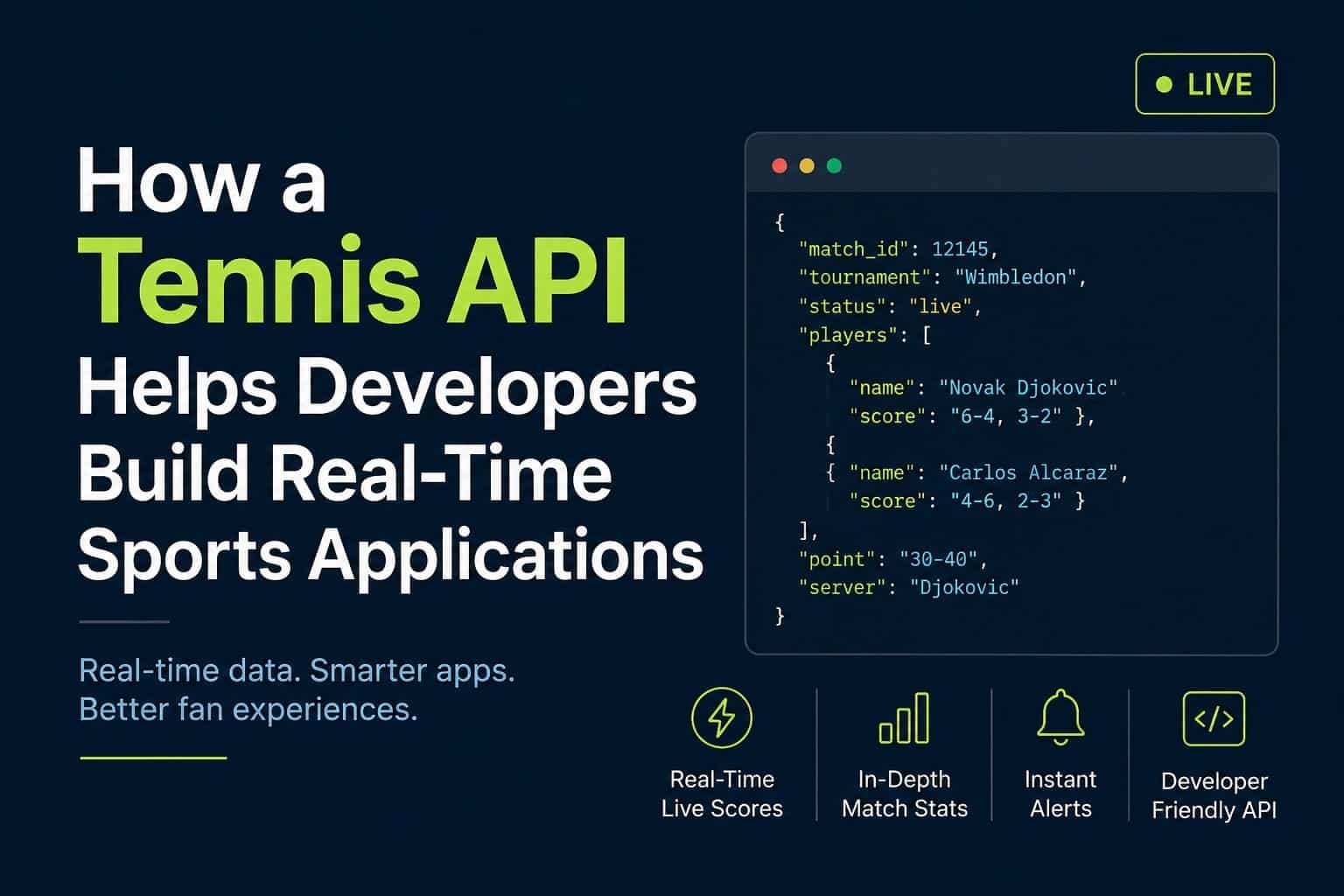
Modern sports applications are expected to deliver information almost instantly. Whether someone is following a tournament from a mobile app, checking a live scoreboard, analyzing player performance, or monitoring match activity on a sports platform, users increasingly expect data to update while the action is happening.
For developers, delivering that experience can be challenging. Tennis matches generate constantly changing information, including sets, games, points, serving status, match statistics, and other events. Collecting, normalizing, and delivering this information reliably requires a dedicated data infrastructure.
This is where a tennis data API becomes valuable.
Instead of building an entire sports-data collection system from scratch, developers can connect their applications to a tennis api and retrieve structured tennis information through application-friendly endpoints. The application can then transform that data into scoreboards, dashboards, notifications, analytics tools, or other real-time sports experiences.
This approach can significantly simplify development while making it easier to scale a tennis-focused application.
What Is a Tennis API?
A tennis API is an application programming interface that allows software applications to request structured tennis data programmatically.
Rather than manually collecting information from websites or maintaining a large internal database, an application sends a request to an API endpoint. The service processes that request and returns structured information, commonly in JSON format.
Depending on the provider and subscription level, tennis data can include:
- Live and upcoming matches
- Current scores
- Tournament information
- Player profiles
- Match results
- Historical matches
- Point-by-point information
- Rankings
- Match statistics
- Market or odds data
JSON responses are particularly useful because modern programming languages and frameworks can process them easily.
A simplified response might conceptually look like this:
{
  "match_id": 18042,
  "status": "live",
  "sets": [1, 0],
  "games": [[6, 4], [3, 5]],
  "points": ["30", "40"],
  "server": 1
}
A developer can convert information like this into a user-friendly interface without requiring users to understand the underlying data structure.
Why Real-Time Tennis Applications Need Reliable Data
Sports applications are highly dependent on timing.
For a static website, receiving information several minutes late might not matter. For a live sports product, however, stale information can substantially reduce the usefulness of the application.
Consider a tennis scoreboard.
During a match, the application may need to display:
| Data Type | Example Use |
|---|---|
| Match status | Show whether a match is upcoming, live, or completed |
| Set score | Display the number of sets won |
| Game score | Show progress within the current set |
| Point score | Display 15, 30, 40, advantage, or tiebreak progress |
| Server | Identify which player is serving |
| Player data | Populate names, profiles, rankings, or related information |
| Match statistics | Power deeper analysis and match dashboards |
| Market data | Support eligible sports-data or market-analysis products |
The challenge becomes greater when an application tracks multiple tournaments and matches simultaneously.
Instead of treating every match as a separate data problem, an API provides developers with a standardized way to retrieve information.
How a Tennis API Simplifies Application Development
One of the biggest benefits of using an API is separation of responsibilities.
The sports-data provider focuses on collecting, processing, and exposing the data. The application developer focuses on creating the product.
A typical architecture may look like this:
Tennis data source → API → Application backend → Cache/database → Frontend → User
This structure allows developers to concentrate on features that differentiate their application rather than spending most of their development time building data-acquisition infrastructure.
1. Building Live Scoreboards
A live scoreboard is one of the most obvious uses of tennis data.
Developers can request active matches, process the returned data, and display the results in a web or mobile interface.
A scoreboard could include:
- Player names
- Tournament name
- Current set
- Set scores
- Current game
- Point score
- Serving player
- Match status
The frontend can then refresh information periodically or receive updates through a streaming mechanism when the API supports one.
This model can be used for anything from a small tennis website to a more sophisticated sports application covering many concurrent matches.
2. Supporting Point-by-Point Match Experiences
A final score tells only a small part of the story.
For more advanced applications, developers may want to understand how a match progressed point by point. This opens opportunities for detailed match timelines, momentum visualizations, break-point analysis, and interactive match centers.
Point-level information can help developers build features such as:
- Match progression timelines
- Break-point indicators
- Serve tracking
- Game-by-game visualizations
- Momentum analysis
- Historical match replay interfaces
The depth of available point-by-point information varies by API provider and service tier, so developers should confirm coverage before designing features around it.
LiveTennisAPI, for example, separates basic live-score access from more advanced historical and live point-level functionality across its service tiers.
3. Creating Sports Analytics Dashboards
APIs are not limited to consumer-facing scoreboards.
Developers can also use structured tennis data to create analytics products for researchers, journalists, sports analysts, content teams, and technically sophisticated tennis fans.
An analytics dashboard could combine several data categories.
| Dashboard Component | Data Required | Potential Output |
|---|---|---|
| Player overview | Player and ranking data | Profile dashboard |
| Recent matches | Historical results | Form analysis |
| Live match | Score information | Real-time match center |
| Point history | Point-by-point data | Momentum visualization |
| Match statistics | Serve and return stats | Performance comparison |
| Market information | Market prices | Market-monitoring dashboard |
The API supplies structured information, while the developer decides how that information should be analyzed and presented.
That distinction is important: raw data alone does not create a useful sports product. The application layer determines the user experience.
4. Developing Tennis and Sports Betting Applications
Real-time tennis data can also be useful in applications built for sports-market monitoring, betting analytics, or quantitative research, subject to applicable laws and platform requirements.
These products may need to combine match state with market information.
For example, a developer might build a dashboard that displays:
Current score + server + match events + market price movement
Having related information available through a consistent data structure can simplify the engineering required to keep different parts of the application synchronized.
Developers should still consider latency, data licensing, regulatory requirements, and responsible-use policies when creating betting-related products.
An API provides the data infrastructure; it does not remove those operational and compliance responsibilities.
5. Building Automated Alerts and Notifications
Not every user wants to keep a scoreboard open throughout an entire match.
Notifications can make sports applications considerably more useful.
Depending on available data and application logic, developers could create alerts for events such as:
- Match starting
- Set completed
- Match completed
- Break-point opportunity
- Score change
- Selected player entering a live match
The application backend can monitor relevant events and trigger push notifications, emails, messaging-bot updates, or internal application alerts.
Event-driven systems can be especially useful when a data provider offers streaming or webhook functionality because the application may not need to continuously request the same endpoint to discover whether something has changed.
REST APIs vs. Streaming Data
One technical decision when developing a real-time sports application is how frequently the application needs updates.
REST APIs work through requests and responses.
For example:
Application → GET request → API → JSON response
This model is simple and widely supported.
For some applications, polling a REST endpoint at appropriate intervals is sufficient. More demanding real-time products may benefit from technologies such as WebSockets, where an ongoing connection can deliver new information as it becomes available.
The difference can be summarized as follows:
| Method | How It Works | Good For |
|---|---|---|
| REST | Application requests current data | Fixtures, profiles, results, periodic score updates |
| Polling | REST requests repeat at intervals | Simple live scoreboards |
| WebSocket | Persistent connection pushes updates | Highly responsive live applications |
| Webhooks | Server sends events to a configured endpoint | Alerts and backend automation |
The right method depends on the product.
A hobby scoreboard and a high-volume real-time sports platform have very different infrastructure requirements.
Why JSON Makes Sports API Integration Easier
JSON has become one of the most common formats for modern web APIs because it is lightweight, readable, and supported across programming environments.
Developers working with JavaScript, TypeScript, Python, PHP, Java, Go, or other languages can parse JSON responses and convert them into application objects.
A frontend might use returned match information to create a scoreboard, while a backend service stores selected fields for later analysis.
This also supports multi-platform development.
The same API can potentially supply data to:
- Websites
- iOS applications
- Android applications
- Desktop dashboards
- Internal analytics systems
- Messaging bots
- AI tools
- Data pipelines
Developers therefore do not necessarily need a separate tennis-data source for every interface they build.
Key Factors to Consider When Choosing a Tennis Data API
Not every API is suitable for every sports application.
Before integrating a provider, developers should evaluate both the available data and the technical characteristics of the service.
Coverage
Check which competitions and tours are included.
A product focused on professional tennis may require ATP and WTA coverage, while a broader application may also need Challenger and ITF events.
Data Depth
A basic application might only require current scores.
An analytics product may need considerably more:
- Historical results
- Point-level information
- Player data
- Rankings
- Statistics
- Market prices
Paying for large quantities of data that an application never uses can add unnecessary cost, while choosing an API without sufficient depth can require a difficult migration later.
Update Method
Developers should determine whether REST polling is sufficient or whether the application requires push-based updates through technologies such as WebSockets or webhooks.
Documentation
Good API documentation can dramatically reduce integration time.
Developers should look for:
- Endpoint references
- Authentication instructions
- Example requests
- Response schemas
- Error descriptions
- Rate-limit information
- SDKs or client libraries
- OpenAPI specifications
Clear documentation also makes maintenance easier when new developers join a project.
Rate Limits
Applications should understand how many requests they can make within the provider’s limits.
A development project with a handful of users has very different requirements from a public sports platform serving thousands of visitors.
Caching, request deduplication, and sensible polling intervals can help reduce unnecessary API traffic.
A Practical Architecture for a Real-Time Tennis App
A scalable application should generally avoid allowing every frontend user to independently make unnecessary requests to an external sports API.
Instead, developers can introduce a backend layer.
A simplified architecture could be:
Tennis API
↓
Backend data service
↓
Cache / database
↓
Application API
↓
Web and mobile clients
The backend can fetch data, normalize it for the application’s needs, temporarily cache frequently requested information, and distribute it to users.
This architecture provides several advantages.
First, API credentials can remain on the server rather than being exposed unnecessarily in frontend code.
Second, caching can reduce repeated external requests.
Third, developers gain control over how raw tennis data is transformed before it reaches the user interface.
From Raw Tennis Data to a Better User Experience
The real value of a sports API is not simply that it returns scores.
Its value comes from what developers can build with those scores and related data.
Structured tennis information can become:
Raw API response → Useful application feature
A current score becomes a live scoreboard.
Point-level data becomes a match timeline.
Player and historical information becomes an analytics dashboard.
Event data becomes a notification system.
Market information becomes part of a research or monitoring interface.
That transformation is where application design, backend engineering, frontend development, and sports data come together.
Final Thoughts
Building a real-time tennis application involves much more than designing an attractive scoreboard. Developers need a reliable method for retrieving changing match information, processing it efficiently, and delivering it to users without creating unnecessary infrastructure.
A well-designed tennis data API can handle much of the underlying data-access complexity while allowing developers to focus on their actual product.
For simple projects, that might mean displaying current matches and live scores. More advanced applications can incorporate historical information, point-by-point match data, statistics, streaming updates, analytics, and market-related information.
The best approach is to begin with the application’s core requirements, determine the necessary data depth and update frequency, and then select an API and architecture that can grow with the product.
With structured JSON data, documented endpoints, appropriate caching, and a carefully designed backend, developers can turn constantly changing tennis matches into responsive sports applications that are useful before, during, and after play.