
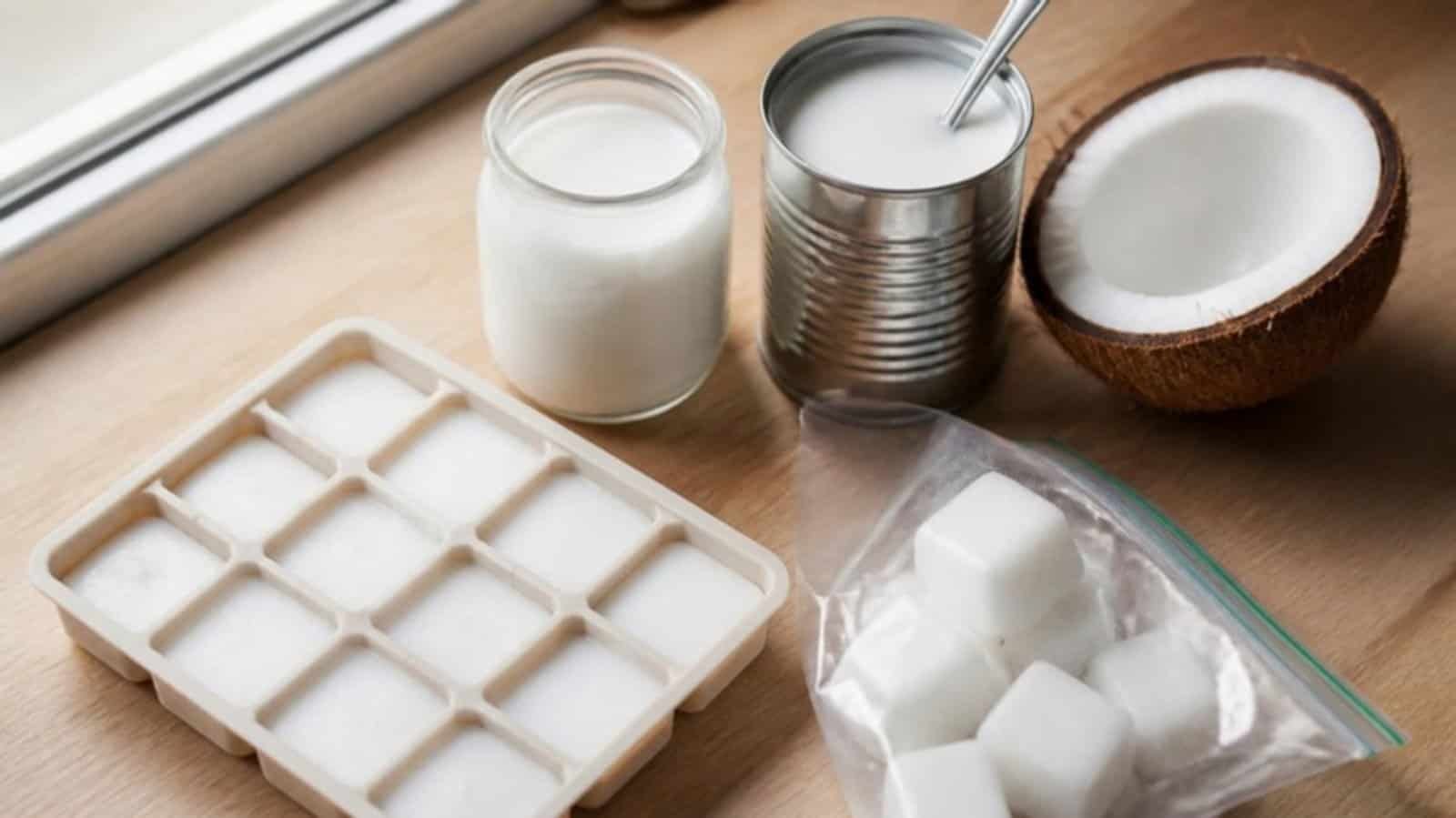
Yes, you can freeze coconut milk. Pour leftover canned coconut milk into an ice cube tray or an airtight container, leave a little room for it to expand, and freeze it. It stays safe in the freezer, but the fat and water separate as it freezes, so thawed coconut milk looks grainy or curdled. A quick whisk or a few seconds with a blender brings it back, and it works well in curries, soups, smoothies and baking.
Below you’ll find how long coconut milk lasts in the fridge once the can is open, two easy ways to freeze it, how to thaw it safely, how to fix the texture, and how to use up that last half-cup before it goes to waste.
Coconut Milk Storage at a Glance
| Type of coconut milk | Where to store it | How long |
|---|---|---|
| Canned, unopened | Cool, dry pantry | Best quality by the date on the can; USDA gives 2 to 5 years for low-acid canned foods |
| Canned, opened | Refrigerator, 40°F (4°C) or below, in a covered glass or plastic container | 3 to 4 days |
| Canned, frozen | Freezer, 0°F (-18°C) or below | Safe indefinitely; best texture within about 1 month |
| Carton coconut milk beverage, opened | Refrigerator | Follow the “use within” days printed on the carton |
| Soup or curry made with coconut milk | Refrigerator / freezer | 3 to 4 days in the fridge; 2 to 3 months in the freezer for best quality |
How Long Does Opened Coconut Milk Last in the Fridge?
Plan to use opened canned coconut milk within 3 to 4 days. Coconut milk is a low-acid food: the FDA’s list of approximate food pH values puts it at about 6.1 to 7.0, and federal rules define low-acid foods as those with a pH above 4.6. USDA’s guidance for opened low-acid canned foods is 3 to 4 days in the refrigerator, compared with 5 to 7 days for high-acid foods such as tomatoes and juices.
Some cooking sites say opened coconut milk keeps for up to a week. We stick with the USDA window because it is the more cautious one, and because there is an easy alternative if you can’t use it in time: freeze it.
A few habits help it last the full 3 to 4 days:
- Move it out of the can. USDA says leftover canned food can stay in the can, but a glass or plastic container with a lid keeps flavor better.
- Refrigerate it promptly. Don’t leave opened coconut milk, or a dish made with it, at room temperature for more than 2 hours (1 hour if it’s above 90°F).
- Label the container with the date you opened it, so you know when the clock started.
- Check your fridge temperature. Keep it at 40°F (4°C) or below.
Canned Coconut Milk vs. Carton Coconut Milk vs. Coconut Cream
“Coconut milk” can mean three different products, and they behave differently in the freezer.
- Canned coconut milk is the thick, rich kind used in curries, soups and baking. University of Florida IFAS Extension notes it can contain up to 400 calories per cup, so it is mostly fat. This is the type most people want to freeze, and the one this guide focuses on.
- Coconut cream is a more concentrated form of coconut milk. It freezes the same way as canned coconut milk and separates the same way when thawed.
- Coconut milk beverage (the carton you’d pour on cereal) is diluted with water and has about 40 calories per cup. You can freeze it, but it separates and turns watery, so it’s best used in smoothies or cooking afterward rather than for drinking.
How to Freeze Coconut Milk
First, give the coconut milk a good stir or whisk. Canned coconut milk often separates into a thick layer of cream on top and thinner liquid below, which is normal. Mixing it before freezing means every portion has the same richness.
Method 1: Freeze It in an Ice Cube Tray (Best for Small Amounts)
This is the most useful method if a recipe only calls for a few spoonfuls, or you want to add a splash to coffee or a smoothie.
- Measure how much one cube of your tray holds (fill one with water and pour it into a measuring spoon). Write it down.
- Pour the stirred coconut milk into a clean ice cube tray. Don’t fill the cups to the brim, because liquid expands as it freezes.
- Freeze until the cubes are solid all the way through, usually a few hours.
- Pop the cubes out and put them in a freezer bag or airtight container. Press out the extra air.
- Label the bag with the date and how much each cube holds.
Method 2: Freeze It in Larger Portions (Best for Curries and Soups)
If you usually cook with half a can or a full can at a time, freeze it in those amounts.
- Pour the stirred coconut milk into a freezer-safe container or a heavy-duty freezer bag, in the portion size you usually cook with.
- Leave some headspace at the top of a rigid container so it has room to expand.
- If you’re using a bag, squeeze out the air, seal it and lay it flat on a tray. Flat bags freeze faster, stack neatly and thaw more evenly.
- Label it with the date and the amount.
Can You Freeze Coconut Milk in the Can?
No. Transfer it to a freezer-safe container first. An opened can isn’t airtight, and an unopened can shouldn’t be frozen: USDA advises keeping canned foods away from freezing temperatures. Store unopened cans in a cool, dry cupboard instead.
How Long Can You Freeze Coconut Milk?
Food kept frozen at 0°F (-18°C) stays safe indefinitely, according to FoodSafety.gov, and the FDA explains that freezing stops bacteria from growing. The limit is quality, not safety. USDA doesn’t publish a specific freezer time for coconut milk; America’s Test Kitchen recommends using frozen coconut milk within about one month for the best texture and flavor. It is still safe after that, but it may pick up freezer odors or lose flavor.
What Happens to Coconut Milk When You Freeze It?
Coconut milk is an emulsion of fat and water. Freezing breaks that emulsion, so when it thaws, the fat and proteins clump together and separate from the liquid. It can look curdled, grainy or watery. The National Center for Home Food Preservation lists milk sauces, cream fillings and mayonnaise among foods that separate after freezing for the same reason.
This is a texture change, not spoilage. The flavor stays close to fresh coconut milk, and the texture is easy to fix.
How to Thaw Frozen Coconut Milk Safely
Never thaw coconut milk on the counter. Use one of these methods instead.
- In the refrigerator (safest). Move the container to the fridge the night before you need it. Small cubes thaw in a few hours; a large container can take a day. USDA notes that food thawed in the fridge can be refrozen without heating it first, though the texture suffers a little more each time.
- In cold water. Seal the coconut milk in a leak-proof bag and submerge it in cold tap water. Use it right away once it has thawed, and cook it before refreezing.
- Straight into the pot. For curries, soups and sauces you don’t need to thaw it at all. Drop the frozen cubes or block into the simmering dish and stir until melted. Add a few extra minutes of cooking time.
If you reheat a soup or sauce that contains coconut milk, USDA recommends bringing it to a rolling boil, and leftovers in general should reach 165°F (74°C).
How to Fix Grainy Coconut Milk After Thawing
- Blend it. An immersion blender or a regular blender for about 30 seconds re-emulsifies the fat and liquid. America’s Test Kitchen found blended thawed coconut milk performed much like a freshly opened can.
- Whisk it hard if you don’t have a blender. It won’t be perfectly smooth, but it will be fine in cooked dishes.
- Warm it gently in a saucepan while whisking. Heat helps the fat melt back into the liquid.
- Let the recipe do the work. In a simmering curry or soup, small clumps melt in and disappear.
Best Ways to Use Frozen Coconut Milk
Thawed coconut milk is best in recipes where it gets heated or blended:
- Curries, dals and stews
- Soups, such as pumpkin, sweet potato or carrot soup
- Smoothies (add the frozen cubes directly)
- Oatmeal and rice pudding
- Baking, such as muffins, quick breads and pancakes
- Coconut rice: replace some of the cooking water with coconut milk
It is less suited to recipes that depend on a perfectly smooth, thick texture, such as whipped coconut cream or a no-cook dessert, unless you blend it well first.
Can You Freeze Curry or Soup Made With Coconut Milk?
Yes. Cool it quickly, refrigerate it within 2 hours, and freeze it in airtight containers. FoodSafety.gov gives soups and stews 3 to 4 days in the fridge and 2 to 3 months in the freezer for best quality. The sauce may look a little separated when you reheat it; stirring as it heats usually brings it back together. If you serve it over rice, see our guide to how long cooked rice is good for in the fridge, because rice needs its own careful cooling.
How to Tell If Coconut Milk Has Gone Bad
Throw coconut milk away if you notice any of these:
- A sour or rancid smell, or a sour taste
- Mold or unusual discoloration
- A can that is swollen, leaking, punctured or badly rusted
- Opened coconut milk that has been in the fridge longer than 3 to 4 days
Separation into a cream layer and a liquid layer is not a sign of spoilage. But don’t rely on smell alone: the FDA points out that food can make you sick even when it doesn’t look, smell or taste spoiled. When in doubt, throw it out.
Why Freezing Leftover Coconut Milk Saves Money
Many recipes call for half a can, and the rest often ends up forgotten at the back of the fridge. Freezing it in measured portions means you pay for the whole can and use the whole can. It’s one of many small habits that add up when you’re trying to keep a family grocery budget on track.
If you have more than coconut milk to keep track of, our food-by-food chart of how long leftovers last in the fridge covers cooked meat, rice, pasta, soups and more.
Frequently Asked Questions
Can I freeze coconut milk after opening the can?
Yes. Freezing opened coconut milk is the main reason to freeze it at all. Freeze it within the 3 to 4 days it keeps in the fridge, and the sooner the better for flavor.
Can you refreeze thawed coconut milk?
If it thawed in the refrigerator, USDA guidance says it is safe to refreeze without heating it first. Each freeze makes the texture grainier, though, so freezing in small portions you’ll use in one go is the better plan. Coconut milk thawed in cold water or the microwave should be cooked before refreezing.
Does freezing change the taste of coconut milk?
Only slightly. The main change is texture. Used within about a month and stored airtight, frozen coconut milk tastes much like fresh in cooked dishes.
Can you freeze coconut cream?
Yes, the same way as coconut milk. It will separate when thawed, so blend or whisk it before using it in cooking. It won’t whip as well after freezing.
References
- USDA Food Safety and Inspection Service. Shelf-Stable Food Safety.
- USDA Food Safety and Inspection Service. Leftovers and Food Safety.
- FoodSafety.gov. Cold Food Storage Chart.
- FoodSafety.gov. 4 Steps to Food Safety.
- U.S. Food and Drug Administration. Are You Storing Food Safely?
- U.S. Food and Drug Administration, Center for Food Safety and Applied Nutrition. Approximate pH of Foods and Food Products (2007).
- Code of Federal Regulations. 21 CFR 113.3, Definitions (low-acid foods).
- National Center for Home Food Preservation, University of Georgia. Foods That Do Not Freeze Well.
- University of Florida IFAS Extension. Plant-Based Milks: Coconut (FS411).
- America’s Test Kitchen. Storing Leftover Coconut Milk.