

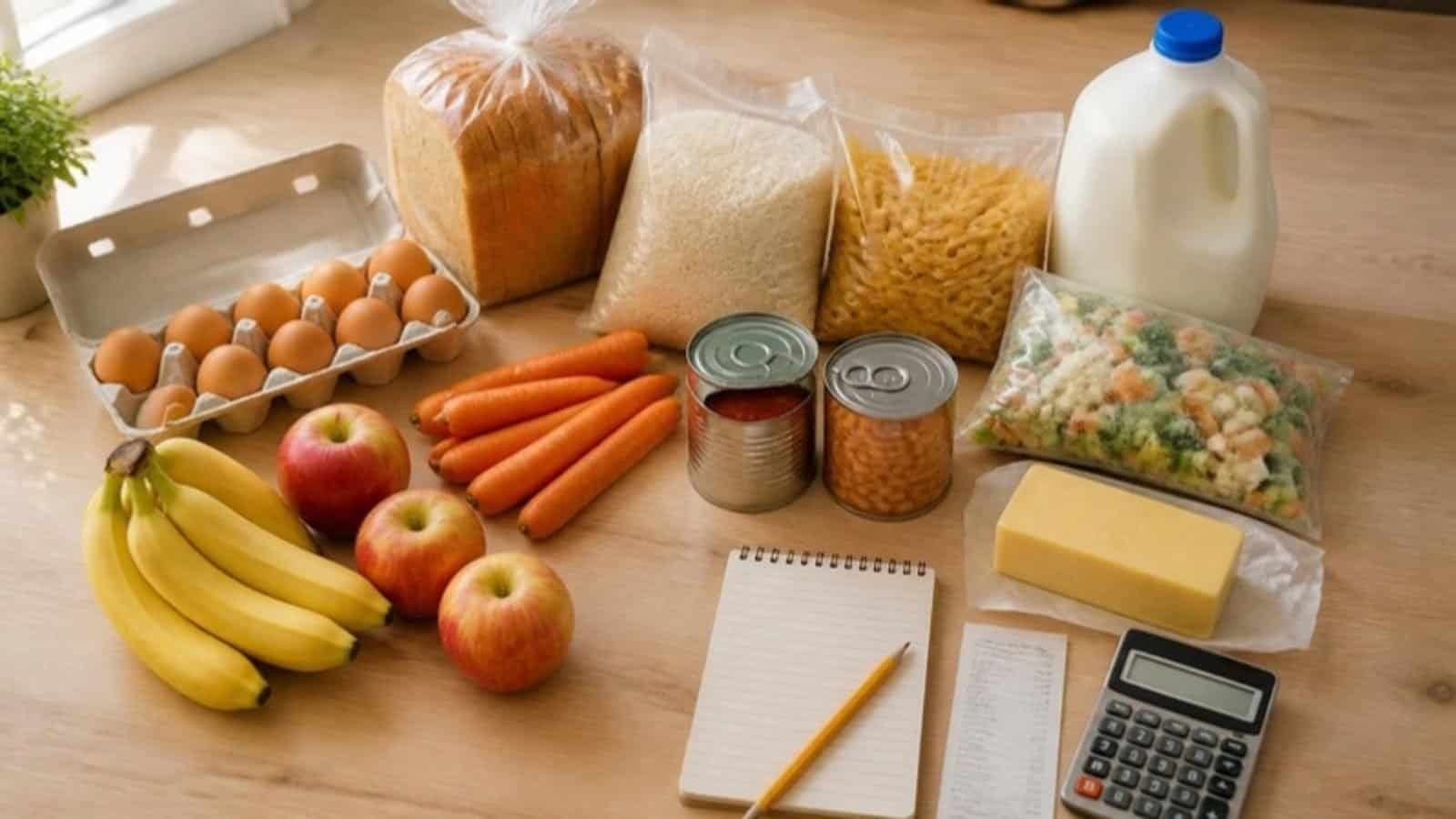
A family of four with two school-age kids needs about $1,024 to $1,679 a month for groceries, according to the USDA’s food plan costs for August 2026. That works out to roughly $236 to $387 a week. Where your family lands depends on how you shop, how old your kids are and where you live.
This guide breaks down the latest USDA numbers in plain language, shows how younger kids and teenagers change the math, and walks you through setting a grocery budget that fits your own family, plus practical ways to bring it down.
How Much Should a Family of 4 Spend on Groceries?
For a family of four with two adults and two children ages 6 to 11, the USDA’s August 2026 food plans range from $1,023.70 a month on the Thrifty plan to $1,678.70 a month on the Liberal plan. If you cook at home most nights and buy a mix of store brands and name brands, the range between the Thrifty and Moderate-Cost levels is a sensible place to start.
Monthly grocery budget for a family of 4 (USDA food plans, August 2026)
| USDA food plan | Weekly | Monthly | Yearly (estimated) |
|---|---|---|---|
| Thrifty | $236.30 | $1,023.70 | $12,284 |
| Low-Cost | $259.80 | $1,125.80 | $13,510 |
| Moderate-Cost | $320.50 | $1,388.20 | $16,658 |
| Liberal | $387.40 | $1,678.70 | $20,144 |
These figures cover food bought at the store and prepared at home. They don’t include restaurant meals, takeout or non-food items. The USDA updates them every month to reflect food price changes.
What the Four USDA Food Plans Mean
The USDA publishes four food plans. Each one describes a healthy diet of meals and snacks prepared at home, priced at a different spending level. They are useful benchmarks because they are based on nutrition, not just on what people happen to spend.
Thrifty Food Plan
The Thrifty plan is the lowest-cost of the four. It prices a nutritious diet on a limited budget, and the USDA uses it as the basis for SNAP benefit amounts. In practice, a family budgeting at this level usually cooks most meals from scratch, leans on staples like beans, rice, eggs, oats and frozen produce, and buys very few convenience foods.
Low-Cost Plan
The Low-Cost plan is the next level up. In practice, it allows a bit more flexibility, such as more meat, more fresh produce or a few more prepared items, while still being careful with money.
Moderate-Cost Plan
The Moderate-Cost plan sits in the middle of the range. In practice, it leaves room for some convenience foods, a wider variety of fresh produce and occasional name-brand favorites.
Liberal Plan
The Liberal plan is the highest-cost level. In practice, it leaves room for more premium choices, such as specialty items, more organic produce or higher-priced cuts of meat.
None of these plans is “right” or “wrong.” They simply give you a reference point so you can see whether your spending is lean, typical or generous for a family your size.
Why Your Family’s Grocery Budget May Be Different
The table above is based on one specific family. Your real number can be noticeably higher or lower.
Your kids’ ages
Young children eat less, so families with toddlers and preschoolers need a smaller grocery budget. Here is the same calculation for two adults with children ages 2–3 and 4–5:
Grocery budget for a family of 4 with young children (August 2026)
| USDA food plan | Weekly | Monthly |
|---|---|---|
| Thrifty | $215.40 | $933.50 |
| Low-Cost | $218.20 | $945.20 |
| Moderate-Cost | $268.40 | $1,162.70 |
| Liberal | $331.20 | $1,434.90 |
Compared with a family whose kids are 6 to 11, that is about $90 less per month on the Thrifty plan and about $226 less on the Moderate-Cost plan.
Teenagers eat more
Costs rise quickly once kids hit their teens. On the Thrifty plan, the USDA prices a boy ages 14–19 at $326.20 a month, compared with $241.90 for a child ages 9–11. A family of four with two teenagers (one boy, one girl, both 14–19) would need about $1,158.80 a month on the Thrifty plan and about $1,460.60 on the Moderate-Cost plan, based on USDA’s individual figures.
Household size
The USDA’s costs for individuals assume a four-person household. Larger households can buy in bigger quantities and stretch food further, while smaller households tend to pay a bit more per person. The USDA suggests these adjustments to the total for your household’s members:
- 1 person: add 20%
- 2 people: add 10%
- 3 people: add 5%
- 4 people: no adjustment
- 5 or 6 people: subtract 5%
- 7 or more people: subtract 10%
Where you live
The USDA figures are U.S. averages. Grocery prices vary from region to region and even between stores in the same town, so families in higher-cost areas may need to budget above these numbers to eat the same way.
Eating out and special diets
If your family eats out often, your grocery bill may look low, but your total food spending won’t be. The food plans also assume a typical diet. Food allergies, medical diets or a preference for organic and specialty foods can raise costs above the plan levels.
Average Grocery Bill for a Family of 4 vs the USDA Plans
It helps to separate two different questions: what a nutritious diet costs, and what households actually spend.
The USDA food plans answer the first question. The second comes from the U.S. Bureau of Labor Statistics Consumer Expenditure Survey. Its most recent annual release, covering 2024, found that the average U.S. household spent $6,224 on food at home for the year, or about $519 a month.
That BLS figure is lower than the USDA numbers for a family of four because it averages households of every size, including single people and couples. It is a useful national snapshot, but it is not a benchmark for a family of four. For that, the USDA food plans are the better guide.
How to Set Your Family’s Grocery Budget in 4 Steps
You can build a personal benchmark in about 15 minutes using the USDA’s figures for individuals.
Step 1: Choose the plan that matches how you shop
If you cook most meals from scratch and buy store brands, start with Thrifty or Low-Cost. If you buy some convenience foods and name brands, start with Moderate-Cost.
Step 2: Add up each person in your family
Find each family member’s age group in the USDA’s latest monthly table and add the costs together.
For example, a family with two adults ages 20–50, a 10-year-old and a 4-year-old on the Moderate-Cost plan would add:
- Woman, 20–50: $336.10
- Man, 20–50: $398.10
- Child, 9–11: $349.50
- Child, 4–5: $221.40
Total: $1,305.10 a month, or $301.30 a week (August 2026 USDA figures).
Step 3: Adjust for household size
With four people, no adjustment is needed. For other household sizes, apply the USDA percentages listed above.
Step 4: Compare with your real receipts
Add up two or three months of actual grocery spending and compare it with your USDA benchmark. If you are well above it, the tips below can help you close the gap. If you are below it and your family is eating well, you’re already doing great. Then set a weekly target, because a weekly number is easier to track at the checkout than a monthly one.
Weekly vs Monthly Grocery Budget for a Family of 4
Many families find a weekly budget easier to manage. Based on the August 2026 USDA figures for two adults and two children ages 6–11:
- Thrifty: about $236 a week, $34 a day, or roughly $8.40 per person per day
- Moderate-Cost: about $321 a week, $46 a day, or roughly $11.40 per person per day
- Liberal: about $387 a week, $55 a day, or roughly $13.80 per person per day
Daily and per-person figures are calculated from USDA monthly costs.
Seeing the per-person, per-day number can be eye-opening. On the Thrifty plan, about $8.40 has to cover breakfast, lunch, dinner and snacks for one person.
Grocery Budget for a Family of 3 or 5
Using the USDA’s household-size adjustments and August 2026 figures:
- Family of 3 (two adults and a child ages 6–8): about $821 a month on the Thrifty plan and about $1,091 on the Moderate-Cost plan, after adding 5%.
- Family of 5 (two adults and children ages 2–3, 6–8 and 9–11): about $1,136 a month on the Thrifty plan and about $1,516 on the Moderate-Cost plan, after subtracting 5%.
Your own numbers will shift with your children’s ages, so use the four steps above for an exact figure.
How to Lower Your Grocery Bill Without Eating Worse
A lower grocery bill doesn’t have to mean boring meals. These habits make the biggest difference for most families.
Plan meals around what’s on sale
Check your store’s weekly ad before you plan the week, then build dinners around the discounted proteins and produce. Planning first and shopping second also cuts down on impulse buys.
Buy store brands for staples
Store-brand flour, sugar, canned tomatoes, beans, rice, pasta, oats and dairy are usually cheaper than name brands. Try a few swaps and keep the ones your family doesn’t notice.
Use frozen fruits and vegetables
Frozen produce lasts for months, so less of it ends up in the trash, and it is ready when you need it. Roasting is an easy way to make it taste great. Here’s how to roast frozen vegetables so they come out crisp instead of soggy.
Cook once, eat twice
Make a bigger batch of taco meat, chili, soup or roasted chicken and plan a second meal around the leftovers later in the week. Planned leftovers save money and time. Our leftovers storage chart shows how long common cooked foods keep in the fridge and freezer.
Keep a working pantry
A pantry stocked with low-cost basics, such as rice, dried or canned beans, pasta, oats, canned tomatoes, broth and spices, makes it easier to pull together a meal without an extra trip to the store.
Waste less food
Use what you already have before you buy more. Shop your fridge and pantry before writing a list, put older items in front, and freeze extras before they spoil. Even odds and ends can be saved; you can freeze coconut milk left over from a recipe instead of throwing it away.
Compare unit prices
The shelf tag often shows the price per ounce or per pound. Bigger packages are often cheaper per unit, but not always, and only if your family will use it all before it goes bad.
Are Grocery Prices Still Rising in 2026?
Yes, but more slowly than in recent years. The USDA Economic Research Service forecast in September 2026 that food-at-home prices will rise about 2.4% in 2026, within a range of 1.8% to 3.0%. Grocery prices rose 2.3% in 2025.
For planning purposes, review your grocery budget at least once a year. The USDA updates its food plan costs every month, so checking the latest figures before you set next year’s budget keeps your number realistic.
Frequently Asked Questions
What is the average grocery bill for a family of 4?
The USDA’s August 2026 food plans put a family of four with children ages 6–11 at $1,023.70 to $1,678.70 a month, depending on the plan. Families with younger children need less, about $933.50 to $1,434.90 a month. The USDA figures reflect the cost of a nutritious diet prepared at home.
Is $1,000 a month a lot for groceries for a family of 4?
No. For a family with two school-age kids, $1,000 a month is just under the USDA’s lowest-cost Thrifty plan ($1,023.70 in August 2026), so it is a lean budget. For a family with toddlers or preschoolers, $1,000 sits slightly above the Thrifty level of $933.50.
How much should a family of 4 spend on groceries per week?
Based on August 2026 USDA figures, about $236 to $387 a week for two adults and two children ages 6–11, and about $215 to $331 a week for two adults with children ages 2–5. If you cook most meals at home, the Thrifty to Moderate-Cost range is a good starting point.
Does a grocery budget include eating out?
No. The USDA food plans only cover food bought at stores and prepared at home. Restaurant meals, takeout and delivery are separate. Many families track them as their own budget line so they can see their total food spending clearly.
Do these grocery budgets include toiletries and household supplies?
No. The USDA food plans price food only. Paper towels, cleaning supplies, diapers and toiletries aren’t included, even if you buy them at the grocery store, so it helps to budget for them separately.
How often does the USDA update its food plan costs?
Every month. The USDA adjusts the costs of all four food plans monthly to reflect changes in food prices, so the figures in this guide will shift slightly over time.
References
- U.S. Department of Agriculture. USDA Food Plans: Cost of Food Monthly Reports (August 2026 Thrifty Food Plan and Cost of Food at Home at Three Levels). https://www.fna.usda.gov/research/cnpp/usda-food-plans/cost-food-monthly-reports
- U.S. Department of Agriculture. USDA Food Plans (overview). https://www.fna.usda.gov/research/cnpp/usda-food-plans
- U.S. Department of Agriculture. Thrifty Food Plan, 2021. https://www.fna.usda.gov/resource/thrifty-food-plan-2021
- U.S. Bureau of Labor Statistics. Consumer Expenditures in 2024 (released December 19, 2025). https://www.bls.gov/news.release/pdf/cesan.pdf
- USDA Economic Research Service. Food Price Outlook: Summary Findings (September 25, 2026). https://www.ers.usda.gov/data-products/food-price-outlook/summary-findings

![Diagram showing a web page passing through three stages—Access, Retrieval and Citation—before being cited as source [1] in an AI-generated answer, beside the title Generative Engine Optimization (GEO).](https://budgetgourmetmom.com/wp-content/uploads/2026/10/generative-engine-optimization-geo-guide-120x86.jpg)